
Runners, here are 3 training metrics you should care about - and 3 you should ignore

Wearable training tech these days is amazing. From tracking our training sessions to monitoring our sleep and recovery, runners have access to a wealth of information that was previously reserved for the professional ranks. In parallel, the platforms we use to analyse, share and store this training data (think Strava, Coros, Garmin Express and TrainingPeaks) are increasingly investing in visualisation tools to help us build a clear picture of our fitness, progression and even performance predictions.
But what good is all that insight if we don’t know how to interpret it and use it to steer our training? At KOTWF, we are big fans of training smarter, not harder. Often, that means keeping things simple. Real progress comes from relentless consistency on the basics, not from getting lost in the weeds.
Ditch the dogma mindset
While training tech has come a long way in a short amount of time, it is still flawed. The numbers on running watches will vary depending on the quality of the satellite connection and even something as silly as a slightly outdated software install could skew the accuracy of your readings. Have you ever gone for a run in a group and noticed that everyone has recorded a slightly different distance? Have you ever run a big city race and noticed that tall buildings can mess with your mile split?
Our point is that your running watch is a tool that you can use, but it shouldn’t be the crystal ball that you listen to unreservedly. Our watches like to give us a Vo2Max score, for example. But, let’s be clear, they have absolutely no idea. All they know about us is our height, age, sex and weight - if we’ve even bothered filling in our profile. The first step in making good use of the data our tech feeds us is understanding the technology’s limitations and flaws.
The second is to know which information is useful - and which just isn’t. So, here are three training data points that are actually important and what to do with them, and three that you can comfortably ignore.
What to watch
1. Heart rate (HR)
There is heart rate data, and there is heart rate data. Most modern running watches will boast accurate wrist-based readings, but trust us when we say it is absolutely worth investing in a decent strap to wear around your arm or chest. Accurate HR data gives you an idea of how hard you’re working regardless of factors like fatigue, weather, terrain, elevation and altitude.
If you have a good idea of your intensity zones and can tie that back to HR, keeping an eye on your numbers either in real-time or as an average throughout the reps/session, can show you whether you’re overreaching or not pushing hard enough.
Our tip: HR is individual and people will hit different numbers at the same intensity zone - this is perfectly normal! There is no optimal number to chase or attain, it’s all relative, and it’s all individual. If you’ve never used HR before, start by keeping an eye on what numbers you hit in your usual runs over a week or two. That will give you a good baseline that you can refer back to. Next time you’re out for an easy recovery run and notice that your HR is ~10bpm higher than usual, it might be a sign that it’s time to ease off the throttle.
“I never train without my heart rate monitor on. It’s especially useful when on recovery sessions where I want to make sure I’m going as easy as possible. I play a game with myself to see how low I can keep my HR average for the duration of the run. If I can keep it under 130bpm, I’ve done a great job! Anything over that means I’ve pushed a bit too hard.” -Bob, KOTWF Endurance Athlete
2. Time
Runners tend to set their runs and intervals in terms of distance (easy 10km, 8km tempo, 20 mile long run) which isn’t necessarily wrong, but our body doesn’t work in metric or imperial - it only understands strain and rest. It sounds silly, but time is the most basic metric on the watch, and yet it’s often dismissed as irrelevant. We would argue there is a real benefit to tracking training volume not in terms of total weekly kilometres or miles, but by time spent training.
We’re not saying to ditch the mileage measurements altogether, but considering time as a parallel metric can help keep consistency throughout the training block without chasing arbitrary numbers. For example, an hour of Battersea Park laps will rack up more miles than an hour of hilly trails in the Dales – but an hour of running is still an hour of running.
Our tip: Next time you head out for a recovery jog, focus on running really easy for 30-60mins regardless of how far that gets you. You could even track your effort level with some solid HR data! Really tuning into perceived effort and time instead of counting down the miles can make sure that we’re applying the right strain at the right moment and not exceeding it to chase arbitrary numbers.
3. Average lap pace
There’s no getting around it, if you are training to hit a certain goal, you need to spend some time training at goal race pace. Obviously you shouldn’t head out and try to hit that goal pace for every run. You would hit that pace in interval sessions that gradually crescendo over the course of your training plan. It’s in those sessions that your watch can really start working for you.
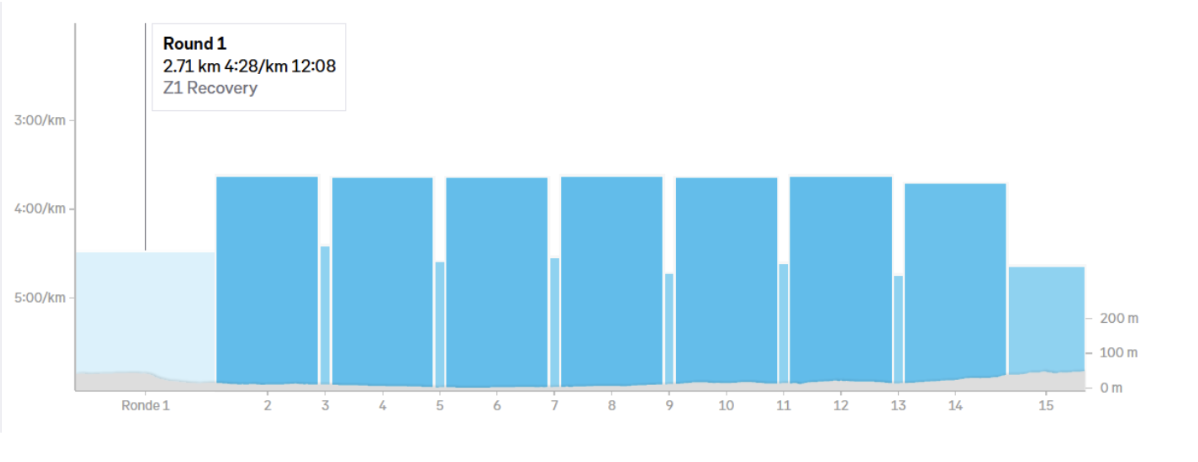
Let’s say your coach gave you a session of 5x5 minutes at goal race pace with 2 minutes of recovery between reps. How would you track that on your watch? Would you stare at your watch the whole session to monitor your pace in real-time? Our advice is to get familiar with the ‘lap’ function - it’s going to be your best friend.
Our tip: Turn off your automatic splits, start taking manual splits and track your average lap pace throughout the session. This will tell you what you’re averaging for each rep in nice chunks and will isolate the warm up, recoveries and cool down from your analysis. Plus, it’ll give you a pretty graph to look at when you’re done!
What to ignore
1. Cadence
In itself, cadence is not useless. For example, it can be interesting to see if your cadence changes significantly between an easy run and a hard interval. This can tell you whether or not you tend to speed up by turning the legs over quicker or by pushing harder off the ground. But, just like HR, cadence is a very individual thing which means there is no such thing as a ‘better’ or ‘worse’ number of steps per minute (no matter what that one influencer is saying in their latest vlog). Unless you’re looking to excel at a hurdling event or in some sort of jump-based field event, there are about a million things you can look at before worrying about your cadence.
2. Stride metrics
Modern watches will provide readings like stride length, running power, stride ratio, stride height, ground time, etc… Going back to the flaws of the tech, it’s important to know that unless you’re wearing a specialised bit of equipment that tracks these things on your foot (like a Stryd foot pod), your watch is guessing at these things. Even if you did want to spend time and effort on making your ground contact time shorter, it would be by such a marginal amount that your watch probably wouldn’t pick up on it anyway, and in the grand scheme of things that isn’t going to move the needle on your performance at all.
3. Calories
At the risk of sounding like a broken record, your watch has no idea how many calories you’ve burned on your run. It can make a rough estimate based on your height, age, weight and gender, but that’s all it is. And even if the reading was accurate, tracking burned calories isn’t going to be helpful in improving our running performance. If anything, it can even be a harmful distraction. Focusing on calories burned during training could also lead to an unhealthy pattern of training to ‘earn’ or ‘justify’ food. This is unhealthy and very counter-productive to good training.
The takeaway
Always remember: your tech is a tool. It’s only as effective as we make it. The most valuable and important metric we have at our disposal is how we feel. Call it Rate of Perceived Exertion (RPE) or whatever you like, but the best athletes are in tune with their bodies and value that input more than any data point.
Take Brazilian short course triathlete, Miguel Hidalgo. He was ranked 2nd in the world in 2025 and is going into 2026 as a hot favourite for the world title. While he tracks his overnight HR and heart rate variability (HRV), his go-to test to see if his body is ready for hard work or not is a simple “stairs test”: he walks up the stairs in his house. If it feels hard on the legs and he’s breathing hard at the top, he knows it’s not a day for an intense session.
So, while this tech is amazing, it cannot – and should not – supersede what our bodies are telling us directly. Whether it’s gauging fatigue levels or monitoring intensity during sessions, sensations paint 90% of the picture. Data helps us frame it.
A good running coach can help you make sense of your training data and build a training plan around the insights it provides. Why not give us a shout about bespoke coaching? We’d be more than happy to help!