
Engine check: what is a blood lactate test and why should you care?

If you follow endurance athletes on social media, odds are you’ve heard of double threshold days, LT1, LT2 and seen the hype around things like ‘the Norwegian Method’. It’s all very sexy: logging inhuman amounts of volume and putting in double session days. It’s aspirational, right? But all of that belies a fundamental focus shift in endurance training.
Let’s use a cheesy analogy here. Endurance training is about turning the athlete into a fast car by marrying a fine-tuned engine (the cardiovascular system) with a strong, agile and resilient chassis (muscles, bones, tendons, etc). What connects them is blood. It’s not only the fuel that powers the car, it’s also the dashboard. The ‘Norwegian Method’ and other currently popular philosophies are built on a scientific understanding of physiology. They study blood to tell them the story of what’s happening under the hood of the car. One of them is the story of blood lactate. But what is it, how do you measure it and why should you care?
Blood lactate 101: the physiology
At its core, endurance training is actually very simple. It comes down to a handful of physiological processes. The one we’ll focus on here is called glycolysis. It refers to the breakdown (lysis) of glucose (glyco) in the cytoplasm (the liquid part of the cell) to produce ATP, amongst other things. To put it very simply, ATP is the energy that powers the muscles. So, the more effective our body is at producing ATP, the more power it can generate and the faster it can move.
Clearly, the first piece of the glycolysis puzzle is the availability of glucose. This leads us down the nutrition path which merits its own article, so we won’t dive into that here. Instead, we’ll focus on the other key puzzle piece: oxygen. Glycolysis is fundamentally an anaerobic process; it can occur with or without oxygen. But while we don’t need it to break down glucose, oxygen is absolutely critical in dictating what happens after glycolysis.
Alongside ATP, pyruvate is another key byproduct of glycolysis. Once this pyruvate is released into the cytoplasm, two scenarios can unfold. In the presence of oxygen, the cell can choose the aerobic route. In this scenario, pyruvate gets transported into the mitochondria where it enters the citric acid cycle which generates even more ATP. Effectively, the aerobic route ‘clears’ the pyruvate out of the cytoplasm and invests it in the mitochondria.
Without oxygen, the cell can’t transport the pyruvate into the mitochondria. In the anaerobic scenario, the pyruvate stays stuck in the cytoplasm and ferments. It becomes lactate. This is where things get tricky for athletes. As lactate builds up and accumulates, the cell gets caught in a reverse feedback loop. It starts slowing down glycolysis to avoid more buildup of lactate. Less ATP is produced, and the athlete increasingly struggles to maintain their effort.
Obviously, the first scenario is the one we want. Through effective endurance training, our aim is to make the aerobic route the go-to for our cells for as long as possible, even at high-intensity. We do this by:
increasing the amount of oxygen available in the cell
increasing the number of mitochondria in the cell
Optimising our cell’s capacity to clear pyruvate out of the cytoplasm
A look under the hood: What’s a blood lactate test?
By testing an athlete’s blood lactate, we can ascertain how efficient their body is at these three things.We do this by measuring the concentration of lactate in their blood with a lactate reader.
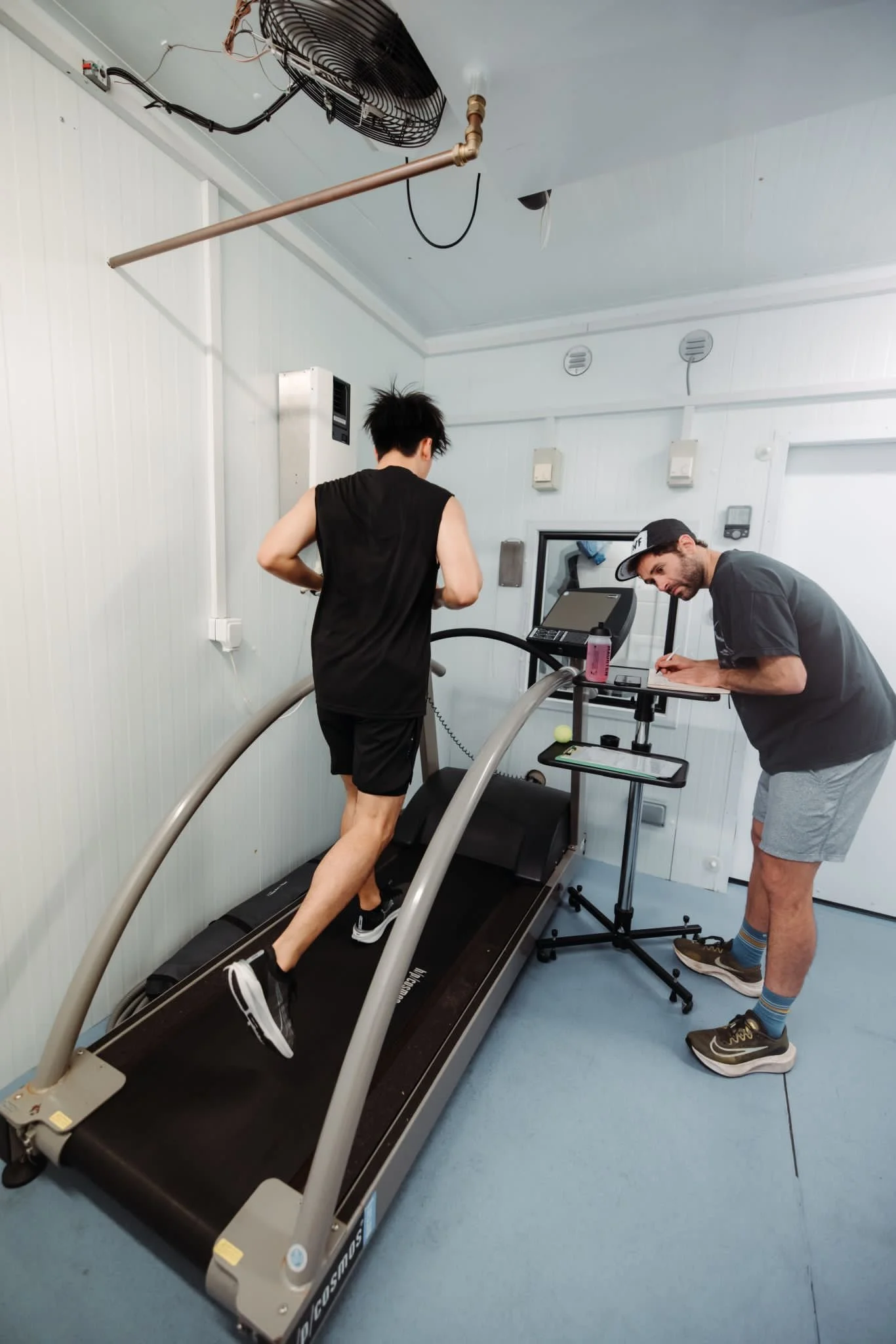
The video above takes you through all the steps. First, the tester (in our case, our trusty guv Sam) takes a blood sample from the athlete at rest to get a baseline. Then, he sets them up on a treadmill (or the cyclist on a static bike) and has them complete a series of intervals at increasing intensity. At the end of each interval (or ‘stage’), Sam takes a blood sample to measure the concentration of lactate in milimoles per liter (mmol/L). The stages will be ramped up in accordance with speed, heart rate, incline or even power output (if done on a bike).
Testing can also be carried out ‘in the field’ - on a track or road loop - which allows athletes to assess lactate responses in a more race-specific environment. We work in partnership with Enduro Lab in Sheffield, who specialise in field-based lactate testing for runners and cyclists wanting real-world data outside of a gym setting. While lab conditions offer tighter control over variables, field testing can provide valuable context for athletes preparing for specific events or terrain.

For reference, most people would log a blood lactate level of 1-2 mmol/L at rest. In aerobically fit people, blood lactate tends to stay below 2 mmol/L during low-intensity training, too. That’s because trained cells know the drill. At low intensity, there is plenty of oxygen available and the aerobic scenario is a no-brainer. The vast majority of pyruvate is transported into the mitochondria and only tiny amounts of lactate accumulate.
Where it gets interesting is when we cross our first lactic threshold, or LT1. Sometimes called the ‘aerobic threshold’, this refers to the intensity point where our cells start producing more pyruvate than our cells can effectively ‘clear’ out of the cytoplasm. At this point, lactate starts to steadily accumulate in the cells and glycolysis starts slowing. Roughly speaking, this can be a good reference point for an athlete’s marathon race effort, for example.
As the intensity ramps up more, the athlete nears their LT2, or ‘anaerobic threshold’. This marks the switch from the aerobic to the anaerobic metabolic system. Past this point, lactate starts to exponentially accumulate in the blood. The effort becomes noticeably hard to sustain and it’s only a matter of time before the athlete is forced to slow or stop altogether.
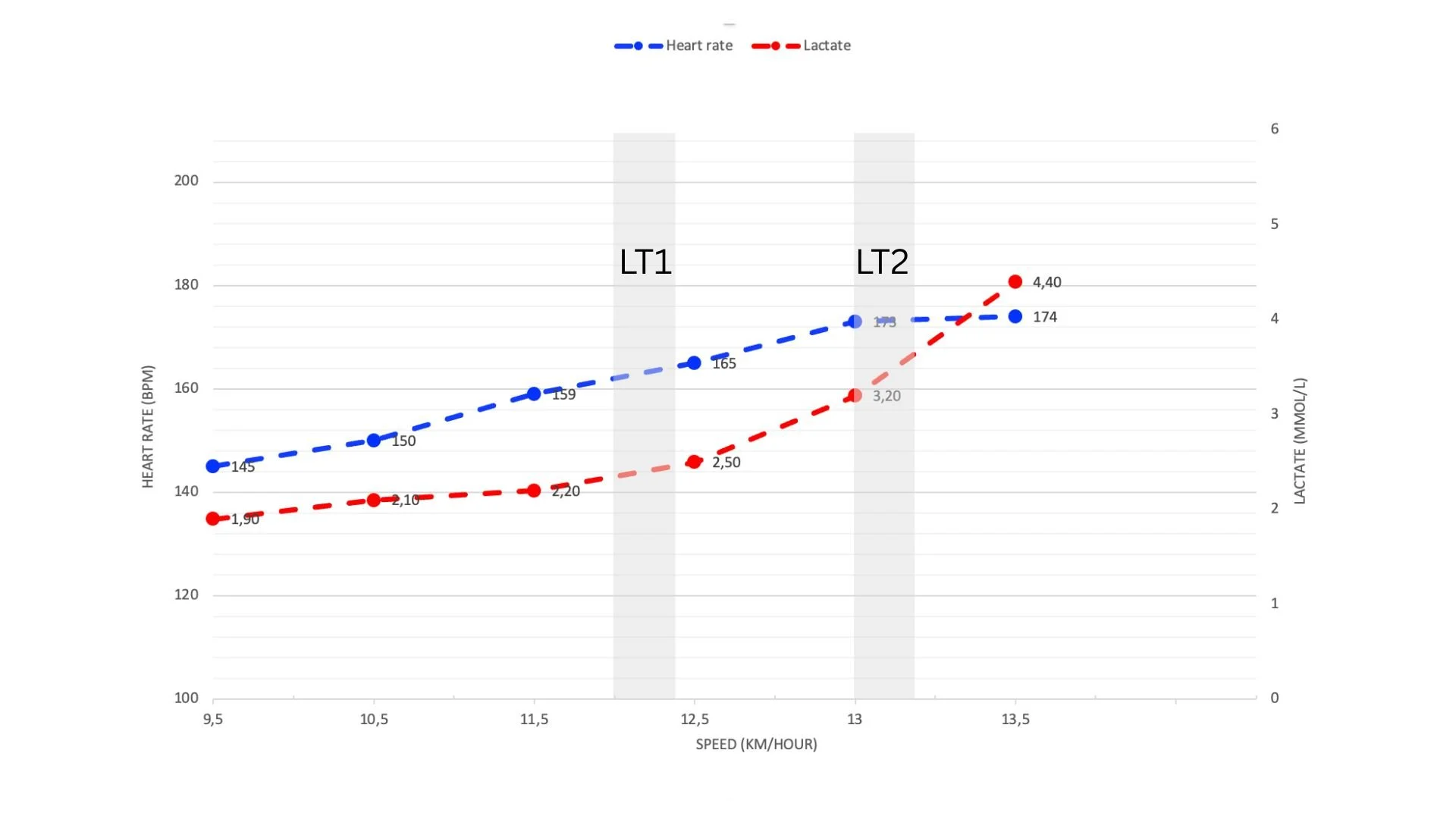
These measurements aren’t the be-all and end-all. But typically speaking the ‘higher’ LT1 and LT2 lie in relation to maximum effort, the fitter the athlete. So, it’s easy to see why some people view these thresholds as performance predictors.
What does this mean for you?
Let’s say you’ve just finished your test (congratulations, by the way). You now know where your lactic thresholds lie in relation to your heart rate, speed and/or power output. What now?
Well, a good coach can take that data and use it to do two things. First, they can tailor your training to your physiology and take the guesswork out of the equation. Let’s say, for example, that your ambition is to improve your marathon time. If you know that your LT1 sits at 160bpm, your coach can design a programme that has you spending increasingly more time at that exact intensity in the buildup to race day. By specifically targeting your LT1, you force your body to adapt to a very precise stimulus and encourage it to become more efficient. Long story, if all goes well, your LT1 will rise and you’ll be able to delay the buildup of blood lactate at goal race effort.
Second, a lactic threshold test gives you and your coach precise reference points that you can use to monitor your progress. By using heart rate, speed and/or power output as ‘stakes in the ground’, a coach can keep a close eye on what happens to their athletes’ lactate thresholds over time. This is something that can be tested either with in-the-field sampling or regular lab tests.
Here’s the real takeaway.
Many of the world’s best athletes across athletics, cycling and triathlon keep a very close eye on their lactic thresholds. Social media feeds are full of athletes pricking their earlobes or fingertips trackside. This is a great way to make sure they’re hitting their session at exactly theright intensity every day. They’re not overcooking or undercooking anything, they’re applying exactly the right heat and exactly the right time. This enables them to accumulate high volumes of quality work in the middle of heaps of low-intensity aerobic stimulus. It’s a game of marginal gains.
But let’s be crystal clear: the vast majority of us are not professionals with the world-class support and equipment we need to emulate this. Worrying about the exact mmol/L measurements in our blood during the Tuesday evening club session is probably overkill. There are several macro factors we can look at before worrying about millimoles. Sleep hygiene, nutrition, strength and conditioning, life stress, consistency and proper recovery are ultimately far more likely to move the needle on our performance. Athletes have been achieving groundbreaking results long before physiologists and coaches even knew blood lactate was a thing, and you can, too.
That being said, we strongly believe that, to achieve more, all athletes should master intensity control and work with their body. That starts with understanding how it works. Booking a blood lactate test is a great way to check your engine and peek under the hood. Why not claim 15% off your first test with code LOGBOOK15 and give it a try?*
*valid for 6 weeks from publication date
Frequently asked questions (FAQs)
-
While the name has been made popular relatively recently by prominent Norwegian endurance athletes like the Ingebrigsten brothers, Kristian Blummenfelt and others, the concept isn’t particularly groundbreaking.
The defining trait of this training philosophy is the use of high-volume, low-intensity work, precisely guided by blood lactate measurement. This manifests in one of the Norwegian Method’s most recognisable traits: the double threshold day. The idea is to bank twice as much ‘quality work’ in a week by incorporating two interval sessions on a ‘hard’ day. The caveat is that these intervals are accompanied by very regular lactate measurements to ensure the athlete stays in the right intensity zone.
-
For everyday training, good glucose-rich whole foods include white rice, potatoes, bananas, white bread, dates, honey, rice cakes, and basically anything ranks highly on the glycaemic index.
During your sessions or races, most athletes steer clear of whole foods and prefer grabbing modern fueling products like gels, drinks and chews. Because pure high-dose glucose tends to cause GI distress in most people, these products often combine glucose with other things like fructose and maltodextrin.
-
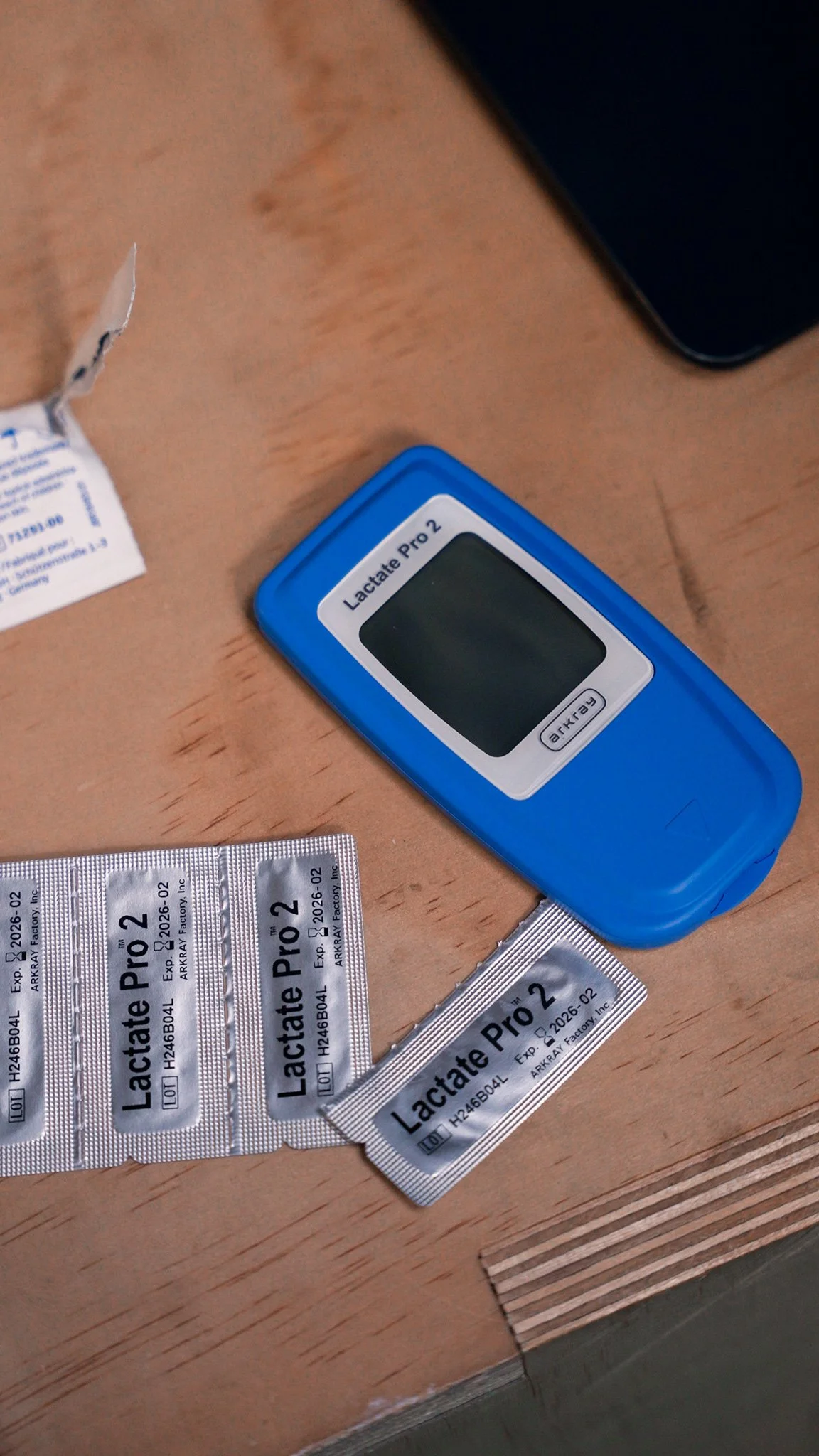
Taking a blood lactate measurement involves taking a small blood sample from the athlete, usually with a small prick on the finger or the earlobe. That blood sample is then placed on a single-use test strip which is inserted into a handheld device.
When collecting samples ‘in the field’ (outside of lab conditions), it can be difficult to get an accurate reading as external factors like wind, rain, sweat and other contaminants could get on the test strip and distort the blood lactate reading.
-
Portable measuring devices and kits can be purchased online. While they are expensive and relatively difficult to use correctly, they are user-friendly and could be a handy addition to any equipment-savvy athlete.
However, it can be extremely difficult to conduct a self-administered test, especially ‘in the field’. Expert guidance and on-hand support in a lab environment will very likely yield more accurate results with far less hassle.